
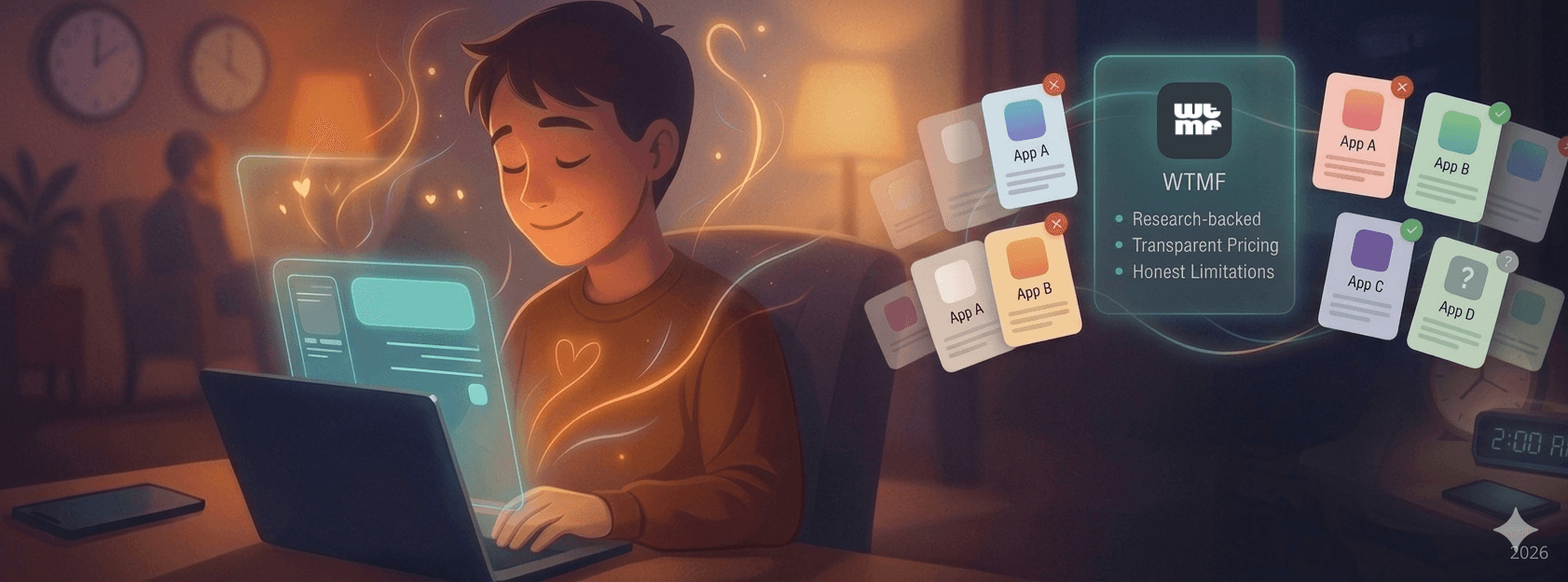
It’s 2 AM. Your brain won’t shut up. Your friends are asleep, your therapist is booked for three weeks, and the group chat hasn’t responded since midnight. So you’re scrolling through the app store, wondering: can an AI friend help?
WTMF Team
It's 2 AM. Your brain won't shut up. Your friends are asleep, your therapist is booked for three weeks, and the group chat hasn't responded since midnight. So you're scrolling through the app store, wondering: can an AI friend help?
Here's the thing. Most "best AI friend" lists are thinly veiled ads for whichever app published them. We're going to be upfront: we built WTMF, an emotional AI companion, so we have skin in this game. But that also means we've tested, studied, and used these apps obsessively. We'll be honest about what each one does well and where each one falls short, including our own.
No AI replaces human connection. But some apps are genuinely better than others at holding space when you need it most. This guide breaks down eight AI friend apps with research backing, real pricing, and honest limitations.
AI friend apps are software applications that use large language models to simulate human-like conversation, emotional support, and companionship through text, voice, or both.
They are not productivity assistants. They are not therapy apps (though some overlap). They sit on a spectrum. On one end are companionship-focused apps like Replika, Nomi, and WTMF that prioritize emotional presence and ongoing relationships. On the other end are therapy-adjacent apps like Wysa that deliver structured evidence-based techniques like CBT and DBT. In the middle sit general-purpose LLMs like ChatGPT that some people use for emotional venting, despite lacking safety guardrails designed for that purpose.
The category is growing fast. Between 2022 and mid-2025, the number of AI companion apps surged by 700%, according to TechCrunch as reported by the APA Monitor. A cross-sectional survey found that 48.7% of individuals used a general LLM for mental health support in the past year, with anxiety, personal advice, and depression as top reasons (JMIR Formative Research, Callahan et al., 2026). A Harvard Business Review analysis identified therapy and companionship as the leading generative AI use case in 2025.
At WTMF, we think the most important distinction is between apps that try to "fix" you and apps that just listen. That lens shapes how we evaluate everything in this guide. We've previously explored how specialized chatbots compare to general-purpose ones for emotional wellness.
We assessed each app across seven criteria that reflect what matters when you're reaching for emotional support at 2 AM.
| Criteria | What We Looked For |
| Emotional Depth | Does it listen and reflect, or just generate a response? |
| Privacy & Data Security | Encryption standards, certifications, data policies |
| Personalization & Memory | Does it remember your context across conversations? |
| Clinical Backing | Published research, expert involvement, FDA designations |
| Pricing Transparency | Free tier value, hidden costs, honest pricing |
| Cultural Sensitivity | Language support, cultural context, inclusive design |
| Honest Limitations | Does the app acknowledge what it can't do? |
These criteria come from our design values at WTMF, but they're grounded in what the research says matters. The APA Monitor and Nature Machine Intelligence both emphasize privacy, honest disclosure, and guardrails as the baseline for responsible emotional AI. This is a topic we've covered in depth on why trust and empathy matter in chatbots.
The OG AI companion with the deepest feature set
Replika launched in 2017 and remains one of the most recognized names in AI companionship, with over 40 million registered users. It offers text chat, voice calls, video calls, and a customizable 3D avatar that you can dress up and interact with in AR. The app learns your communication style over time and maintains a memory bank of personal details from your conversations.
Best for: Long-term companionship seekers who want voice and video calls, avatar customization, and a well-established platform.
Pros:
Cons:
Pricing: Free tier available. Pro: $19.99/month or $5.83/month billed annually ($69.99/year). Lifetime: $299.99 one-time.
The clinically validated emotional wellness coach
Wysa combines an AI chatbot with over 150 CBT, DBT, and mindfulness tools, wrapped in a friendly penguin character. It received FDA Breakthrough Device Designation in 2022 for its AI-based digital mental health conversational agent targeting chronic pain, depression, and anxiety. A peer-reviewed clinical trial published in JMIR found Wysa to be comparable to in-person psychological counseling for managing chronic pain and associated depression (Wysa Clinical Evidence).
Best for: Users who want structured, evidence-based exercises for anxiety, depression, or stress management, not free-form conversation.
Pros:
Cons:
Pricing: Free tier with AI-only tools. Premium plans available; pricing varies by market (typically $53.99-$99.99/year for AI-only premium).
The research-backed daily check-in buddy, now discontinued
Woebot was a relational agent that delivered short, daily CBT-based interactions. It was founded by Stanford-trained clinical psychologist Dr. Alison Darcy, and its prescription digital therapeutic (WB001) received FDA Breakthrough Device Designation in 2021 for postpartum depression treatment. A randomized controlled trial demonstrated that Woebot significantly reduced symptoms of postpartum depression and anxiety, with over 70% of users achieving clinically significant improvement (2 Minute Medicine).
Important: Woebot Health shut down its consumer app on June 30, 2025, citing regulatory challenges around the FDA's lack of clear guidance for LLM-based therapy tools. WB001 never received FDA clearance or approval. We include Woebot here because its clinical evidence remains relevant and its shutdown illustrates the challenges facing therapy-adjacent AI apps.
Best for: No longer available. Its clinical evidence remains a benchmark for evaluating other apps.
Pros (historical):
Cons:
Pricing: Was free to use through the app.
The customizable AI with group chat dynamics
Nomi stands out for deep customization. You can create up to 10 distinct AI companions, each with their own personality, backstory, and appearance, and put them in group chats together. Nomi claims human-level long-term memory, which users consistently praise in reviews. It supports text, voice messages, and AI-generated selfies.
Best for: Users who want multiple AI personalities, group chat dynamics, and deep personalization rather than clinical support.
Pros:
Cons:
Pricing: Free (limited). Monthly: $15.99/month. Quarterly: ~$13.33/month. Yearly: $8.33/month ($99.99/year).
The empathy-first companion that listens without fixing
WTMF was built from a different starting point than most apps in this category. Instead of optimizing for engagement or clinical outcomes, we designed it around a single idea: sometimes you just need someone who listens. No unsolicited advice. No "have you tried being positive?" No botsplaining.
WTMF is powered by Gloofy AI, our proprietary emotional AI model, and offers text chat, AI voice calls, AI journaling with guided prompts, and automatic mood tracking. You choose your AI's personality vibe (Sassy Bestie, Blunt Realist, Philosophical, Calm, Dark Humour) in male or female variants. The "Blunt Realist" option is a deliberate design choice: it pushes back when you need honesty, avoiding the "always validating" trap that the APA's Dr. Saed D. Hill warns about.
Best for: Gen Z and young adults, especially South Asian and Hinglish-speaking users, who want cultural fluency, judgment-free venting, and an AI that gets phrases like "mood off hai" and "uff yaar" without explanation.
Pros:
Cons:
Link: Try WTMF
The empathetic conversationalist with memory depth
Kindroid focuses on creating AI companions with detailed backstories, multi-layer persistent memory, and high-quality voice synthesis. It supports text, voice calls, video calls, and AI-generated selfies. Users can create multiple Kindroids and participate in group chats for roleplay and storytelling. The platform is popular among users who want maximum creative control over their AI companion's personality.
Best for: Users who want realistic, context-aware AI dialogue with strong voice features and deep customization.
Pros:
Cons:
Pricing: Free trial (3 days). Monthly: $13.99/month. 3-month: ~$12.66/month. Yearly: ~$11.66/month ($139.99/year).
The AI emotional health assistant
Youper takes a clinical approach, using CBT, ACT, DBT, and mindfulness techniques to help users manage anxiety and depression. It was co-founded by psychiatrist Dr. Jose Hamilton Vargas and has been clinically validated by Stanford University researchers. A JAMA-published analysis ranked Youper among the most engaging behavioral health apps for anxiety and depression (Youper Clinical Evidence). Earlier trials showed a 48% drop in depression and 43% drop in anxiety scores after four weeks of use (HyperWrite).
Best for: Users who want mood tracking and personalized mental wellness exercises grounded in clinical evidence.
Pros:
Cons:
Pricing: Free tier with basic features. Youper Plus: $69.99/year with 7-day free trial.
The flexible but unguarded option
Nearly half of people who use general LLMs for mental health support turn to tools like ChatGPT and Claude, according to recent research. These tools offer open-ended conversations with broad knowledge and no character limitations. Voice mode on ChatGPT has made interactions more immersive.
Best for: Users who already use these tools and want open-ended conversations without a dedicated companion app.
Pros:
Cons:
Pricing: Free tiers available. ChatGPT Plus: $20/month. Claude Pro: $20/month.
| App | Best For | Clinical Backing | Privacy Level | Memory | Cultural Sensitivity | Free Tier | Starting Price |
| Replika | Long-term companionship | CBT-informed (not FDA) | Low (€5M GDPR fine) | Yes, memory bank | English-focused | Yes | $5.83/mo (annual) |
| Wysa | Structured therapy exercises | FDA Breakthrough Device | High (HIPAA-aligned) | Session-based | Multi-language | Yes (limited) | ~$4.50/mo (annual) |
| Woebot | Daily CBT check-ins | FDA Breakthrough Device, 10+ studies | High (HIPAA-aligned) | Session-based | English-focused | Shut down June 2025 | N/A |
| Nomi | Customization and roleplay | None published | Moderate | Strong long-term | English-focused | Yes (limited) | $8.33/mo (annual) |
| WTMF | Culturally fluent emotional support | No published RCT | High (ISO 27001, E2E encryption) | Yes, persistent | Hinglish, Hindi, English | Yes (beta) | Free (beta) |
| Kindroid | Realistic conversation and voice | None published | Moderate (encrypted messages) | Multi-layer persistent | English-focused | Trial (3 days) | $11.66/mo (annual) |
| Youper | Mood tracking and clinical exercises | JAMA-recognized, Stanford-validated | Moderate | Session-based | Multi-language | Yes (limited) | $69.99/yr |
| ChatGPT/Claude | Open-ended conversation | Research cited, not purpose-built | Low-Moderate | Limited | Multi-language | Yes | $20/mo |
It depends on how you use them.
The benefits are real, with caveats. In a Harvard Business School study, interacting with an AI companion alleviated loneliness on par with interacting with another human and more than activities like watching YouTube videos. Researchers identified "feeling heard" as the primary explanation for why AI companions reduced loneliness (APA Monitor).
AI companion apps also serve as a low-barrier entry point for people who face stigma around therapy, can't afford it, or live in areas where access is limited. A clinical psychologist quoted by the APA described these tools as potentially offering "a low-stakes way to practice conversations with real people."
But the risks scale with use. A joint OpenAI-MIT Media Lab study found that voice interactions with ChatGPT reduced loneliness and problematic dependence more effectively than text alone, but only with moderate use. Heavy daily use correlated with increased loneliness, suggesting that excessive reliance displaces authentic human connection (APA Monitor).
The emotional attachment problem is well-documented too. A Nature Machine Intelligence editorial warned that AI-driven wellness apps can "foster extreme emotional attachments and dependencies akin to human relationships," posing risks like ambiguous loss and dysfunctional dependence (Nature Machine Intelligence, 2025).
As Dr. Saed D. Hill, a counseling psychologist and APA Division 51 president-elect, put it: constant validation without pushback creates unrealistic expectations that human relationships can't match (APA Monitor).
This is why WTMF includes a "Blunt Realist" personality vibe. Constant validation isn't emotional support. Sometimes you need someone (or something) that respectfully pushes back.
AI friend apps and therapy serve fundamentally different purposes. Confusing the two can be harmful. In our previous comparison of AI chat vs. traditional therapy, we broke down these distinctions in detail.
| Dimension | AI Friend Apps | Therapy |
| Purpose | Emotional presence, companionship, venting | Clinical diagnosis, treatment, behavior change |
| Qualification | None required (software product) | Licensed mental health professional |
| Approach | Conversational, adaptive, always available | Structured, evidence-based, scheduled sessions |
| Regulation | Mostly unregulated wellness products | Licensed and regulated by state/federal boards |
| Best for | In-between moments, low-stakes emotional support | Clinical depression, anxiety disorders, trauma, crisis |
Therapy-adjacent apps like Wysa bridge the gap with structured CBT techniques, but even these are designed as supplements to human care, not replacements. Early studies show AI self-help chatbots can reduce depression and anxiety in a few weeks, though no FDA-approved or FDA-cleared AI therapy app currently exists in psychiatry. Woebot's 2025 shutdown underscores this: even with an FDA Breakthrough Device Designation and strong clinical evidence, the regulatory path for AI therapy tools remains uncertain.
WTMF's explicit "not therapy, not a chatbot, just someone who listens" (a philosophy we explored in "Not a therapist, not a bot...") framing aligns with expert consensus on this distinction. We built it into the product because blurring that line is irresponsible, regardless of how good the technology gets. If you're in crisis or need clinical support, please reach out to a licensed professional or call the 988 Suicide and Crisis Lifeline.
Privacy varies wildly across AI companion apps, and it matters more here than in almost any other app category. You're sharing your deepest anxieties, relationship struggles, and mental health history. That data demands serious protection.
What to look for:
Red flags to avoid:
WTMF's approach to privacy reflects our bootstrapped model. We said no to VC funding specifically to avoid the pressure to monetize user data. Our ISO 27001:2022 certification, GDPR compliance, and end-to-end 256-bit encryption aren't marketing bullet points. They're the baseline standard we think every app in this category should meet.
Yes, research shows moderate use can reduce loneliness and provide a helpful low-barrier entry point for emotional support. A Harvard Business School study found AI companions alleviated loneliness on par with human interaction. Heavy daily use may backfire, though, correlating with increased isolation. WTMF's approach focuses on emotional presence without prescriptive advice, which research suggests is what makes users feel genuinely "heard."
AI friend apps like Replika, WTMF, and Nomi focus on companionship, conversation, and emotional presence. AI therapy apps like Wysa deliver structured evidence-based frameworks like CBT and DBT. Neither category replaces licensed professional therapy. The best choice depends on whether you need free-form emotional support or guided clinical exercises.
This is a serious concern. Common Sense Media concluded in April 2025 that social AI companions pose unacceptable risks to youth under 18, finding that some platforms failed to respond appropriately to teens expressing self-harm ideation. In California, S.B. 243 (effective January 1, 2026) now requires nonhuman notifications and crisis-response protocols for companion chatbots. Parental involvement and age-appropriate guardrails are essential.
Most AI companion apps use large language models combined with session memory or persistent memory systems. Apps like Nomi and WTMF offer persistent memory, meaning your AI remembers details from previous conversations and builds on them over time. Therapy-focused apps like Wysa often reset between sessions by design, prioritizing clinical structure over conversational continuity.
Among the apps reviewed, WTMF offers the strongest documented privacy protections: ISO 27001:2022 certification, GDPR compliance, end-to-end 256-bit encryption, and a bootstrapped business model that removes VC pressure to monetize data. Therapy-adjacent apps like Wysa align with HIPAA standards. Replika's €5 million GDPR fine from Italy's privacy authority in 2025 should give privacy-conscious users pause.
The AI friend landscape is evolving fast. So is the research on what helps and what harms. The best AI companion for you depends on what you need: structured exercises, free-form venting, cultural understanding, or clinical backing.
If you want to experience what an empathy-first, culturally fluent AI companion feels like, try WTMF free during beta.
Continue exploring our latest thoughts on AI psychology and emotional intelligence